A successful VVSOR Annual Meeting 2026 - VVSOR - VVSOR

Netherlands Society for Statistics and Operations Research | Dutch
We hope you enjoyed the day as much as we did and if you have any feedback for us, we would be pleased to receive it using the feedback form.
On 5th March we held our 2026 VVSOR Annual Meeting with the theme Chasing Gold: The Promise and Pitfalls of Optimisation.
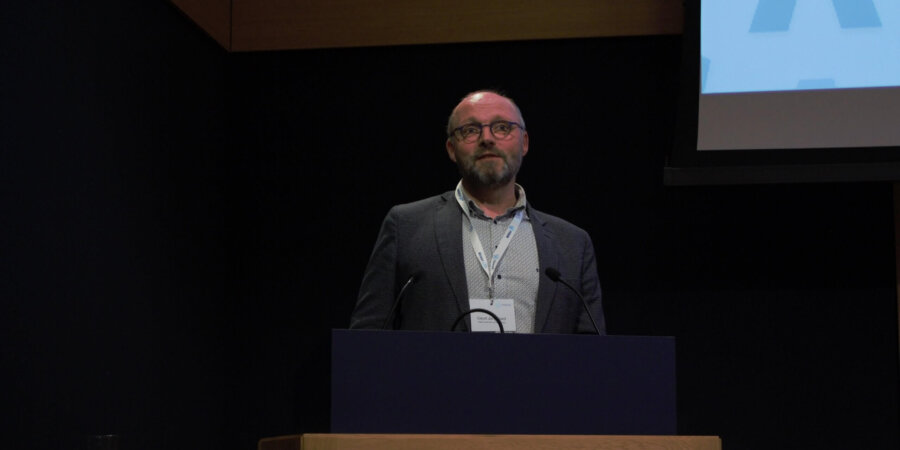
75 attendants joined us for three fascinating keynote speeches by Dr. Sophie Huiberts, Prof. Dr. Rob van der Mei and Prof. Ben Van Calster, as well as four short presentations by distinguished speakers in the fields of statistics and operations research.
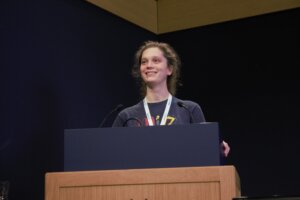
The first keynote speech of the day was given by Dr. Sophie Huiberts of the French Centre national de la recherche (CNRS) and the University of Clermont Auvergne, who presented her innovative approach to proving theorems in theoretical computing. Dr. Huiberts and her collaborators begin by gathering observations from user manuals, source code, datasets and interviews in open-source software engineering, as well as scientific literature, and distilling all these insights into a set of assumptions. These new “grounded” assumptions were then used to show that the worst-case and probabilistic assumptions that many theorems in linear programming are based on are not necessarily true in practice. This opens the door to many useful theoretical results that are more in line with how some of the most popular linear programming optimisation algorithms seem to behave in applications. The full presentation can be accessed here .
The day continued with our first session of short presentations. The first, entitled “So the last can be the first” by Professor Dr. Ruud Koning of Rijksuniversiteit Groningen discussed the informational advantage in speed skating. Namely, pairs of speed skaters who compete last gain an advantage by already knowing the times of their fellow competitors – and thus, the times they would have to beat to win gold. In this compelling presentation, Dr. Koning argued that this advantage is quantifiable, and in the case of this year’s Winter Olympic speed skating competition, for example, had Femke Kok benefitted from this informational advantage by being in the last pair alongside a fast opponent, she possibly could have won gold. The slides of the full presentation are available here
Next, we heard from PhD Candidate at TU Delft, Damla Akoluk, who delivered a fascinating presentation on justice-explicit river basin modelling. Focusing on the transboundary Zambezi river basin, she presented her novel framework which integrates distributive justice metrics as core design principles within an evolutionary decision-support architecture. The results show that this framework exposes asymmetries in how traditional approaches optimising for efficiency, resilience or sustainability miss. This new approach represents a stepping stone towards optimising for justice in pursuit of fairer, more transparent water governance under hydrologic and geopolitical stress.
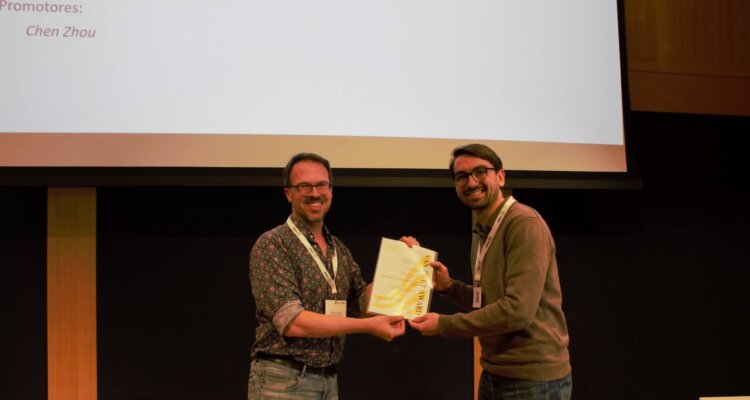
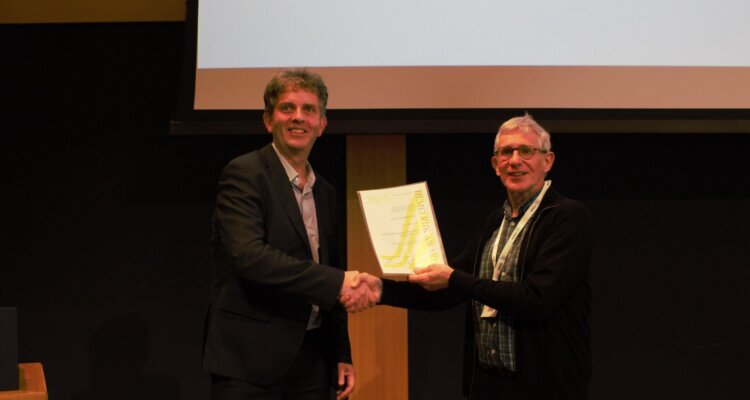
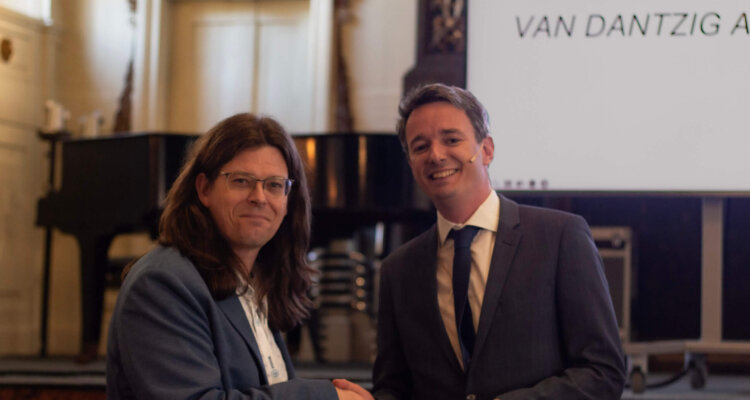
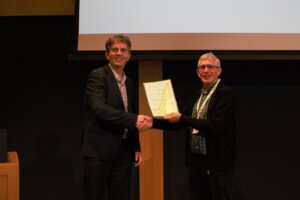
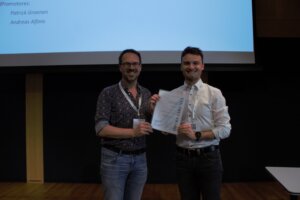
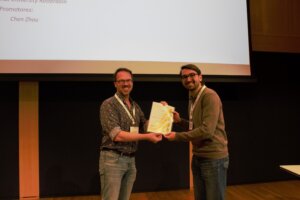
The middle of the day was punctuated by our two award ceremonies: the Van Zwet, announced by the Chairperson of the Jury Prof. Dr. Jelle Goeman and the Hemelrijk award, announced by the Chairperson of the Jury Dr. Ad Ridder.
Next, we heard from our second keynote speaker, Prof. Dr. van der Mei of Centrum Wiskunde and Informatica (CWI) and Vrije Universiteit (VU), whose team introduced an optimisation approach for ambulance route-planning which then became a successful start-up implementing this approach for various ambulance providers in the Netherlands and parts of Germany. The talk began with a walkthrough of the optimisation problem, the way real-time decision making for route planning works, as well as how the team integrated feedback from ambulance drivers and other stakeholders during the project’s development. Finally, Dr. van der Mei rounded off the talk with some tips on turning research into a successful startup.
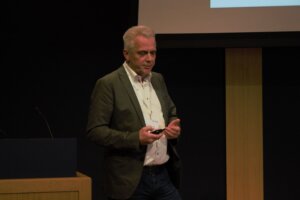
The second short presentation session began with a presentation by Dr. Inez Zwetsloot of the Universiteit van Amsterdam (UvA) who presented her work on challenge-based education. She uses an Agentic AI Framework (Maya) for Intelligent Process Automation in order to streamline the recruitment of ‘challenges’ in educational settings. In particular, the case study she presented focused on how this system can help the AI4Business Lab at the UvA recruit more projects by external partners – these are called “challenges” – for UvA students to work on throughout their studies. The agentic AI framework Maya saves processing time in the recruitment process, aiding the small-scale lab in finding suitable projects for students. The link to the presentation can be found here.
The last short presentation of the day was delivered by Dr. Mario Castro-Gama of Vitens and focused on advanced analytics in drinking water applications. In a presented case study, he talked about how water quality measurements can be optimised by better determining, for example, where to place water quality sensors and how many – especially when working with a large water network. He also presented Vitens’ innovations on skeletonisation: whereby a representative smaller form of a very complex system can be distilled such that optimisation is faster and easier than carrying it out on the full system.
The final presentation of the day was a keynote speech by Prof. Dr. Ben Van Calster. In Prediction Modeling for healthcare: chasing gold or chasing pavements? Prof. Van Calster warned – in line with our theme – about the potential pitfalls of chasing improvements in performance in the field of healthcare prediction. He highlighted how three different sources of uncertainty: estimation uncertainty, model and modeler uncertainty and applicability uncertainty, taken together, may eclipse the small theoretical gains made in this field. To illustrate this point, he discussed, among other points, the findings of a systematic review where he and collaborators found that for many clinical prediction scenarios, there was no performance benefit of machine learning models over logistic regression. The difference in predictive performance in many simulation studies assessing such models seems to be partly attributable to the empirical assessment overfitting the novel, suggested method. Thus, Dr. Van Calster ended the presentation by introducing “net benefit” to the patient as an objective function for assessing and optimising models for clinical use.
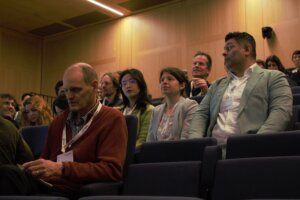
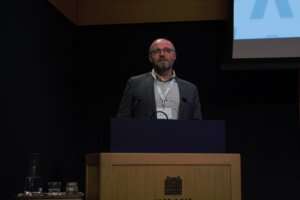
The day was capped by drinks, dinner and a PubQuiz organised by the Young Statisticians.
We hope you enjoyed the day as much as we did and if you have any feedback for us, we would be pleased to receive it using the feedback form.
Text and photos from Elena Petridou.